
Crown Point & Lake County · Residential Roofing
Roofing Company in Crown Point, IN
A brown ring on a bedroom ceiling. Shingle tabs in the flower bed after a storm off the lake. A roof that came with the house and nobody can say how old it is. We work on roofs across Crown Point and Lake County, and we tell you what yours actually needs rather than what sells best.
- Licensed and insured
- Written estimates before any work
- Emergency tarping
- Storm and hail damage inspections
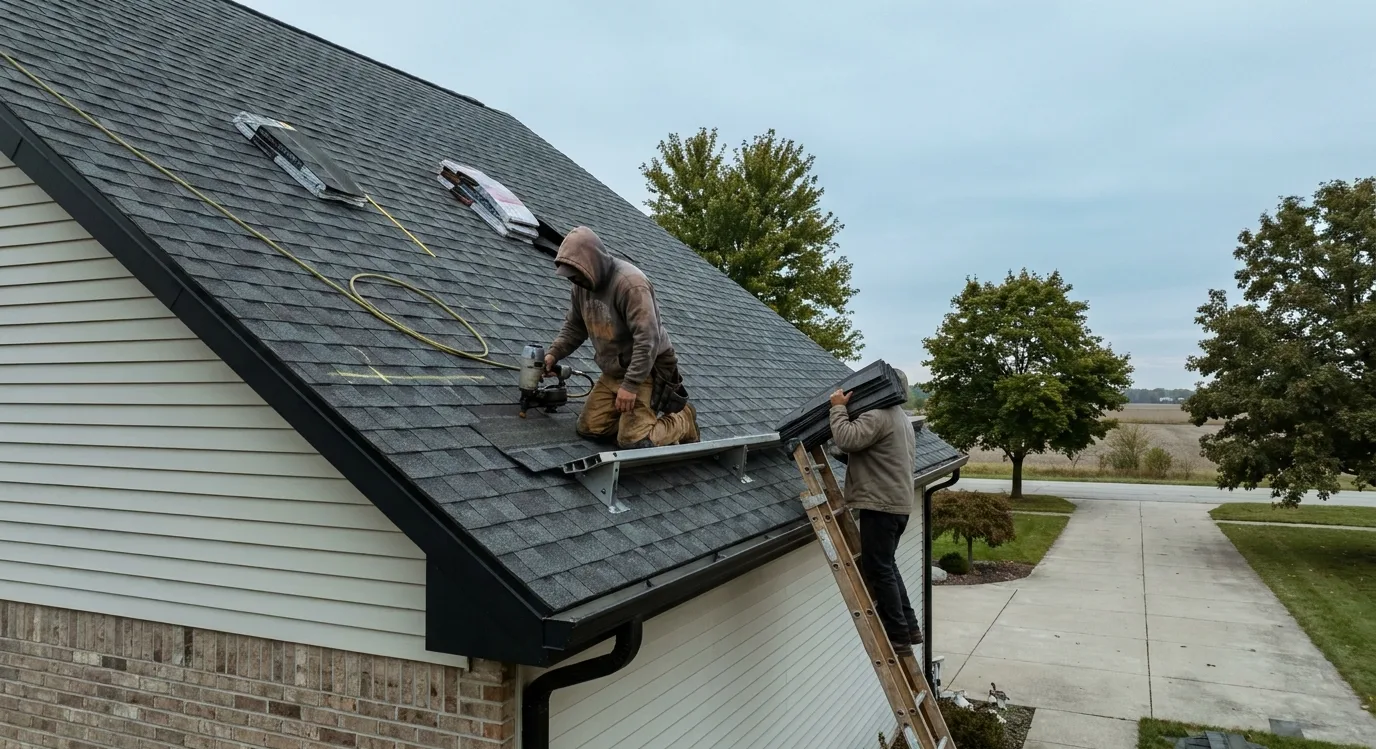
- Full tear-offs, not layovers
Roof repair work we take on in Crown Point
Roof Repair
Leaks traced back to where the water actually gets in, then flashing, boots and worn valleys put right.
Emergency Roof Repair
Openings covered and battened while the weather is still bad, with the permanent repair booked before we leave.
Storm Damage Roof Repair
Wind creasing and hail bruising counted, photographed and written up — whether or not it supports a claim.
How roofs give themselves away around here
Almost nothing on a roof fails without warning. It gives you a season or two of small signals first, and the difference between a repair and a replacement is usually whether anybody was reading them. These are the six that bring people to the phone.
A stain that appears, dries, and comes back
Water is getting in during one particular kind of weather and not the rest of the time. Wind-driven rain from the southwest, or melt running back under a shingle course, both do this. The leak is almost never directly above the stain.
Grit in the gutters and at the downspout
Those granules are the shingle's sunscreen. Once a slope has shed enough of them the asphalt mat below starts baking, and from that point the roof ages faster every year. A handful after a new roof is normal; a steady accumulation is not.
Tabs lifted, creased or gone after a blow
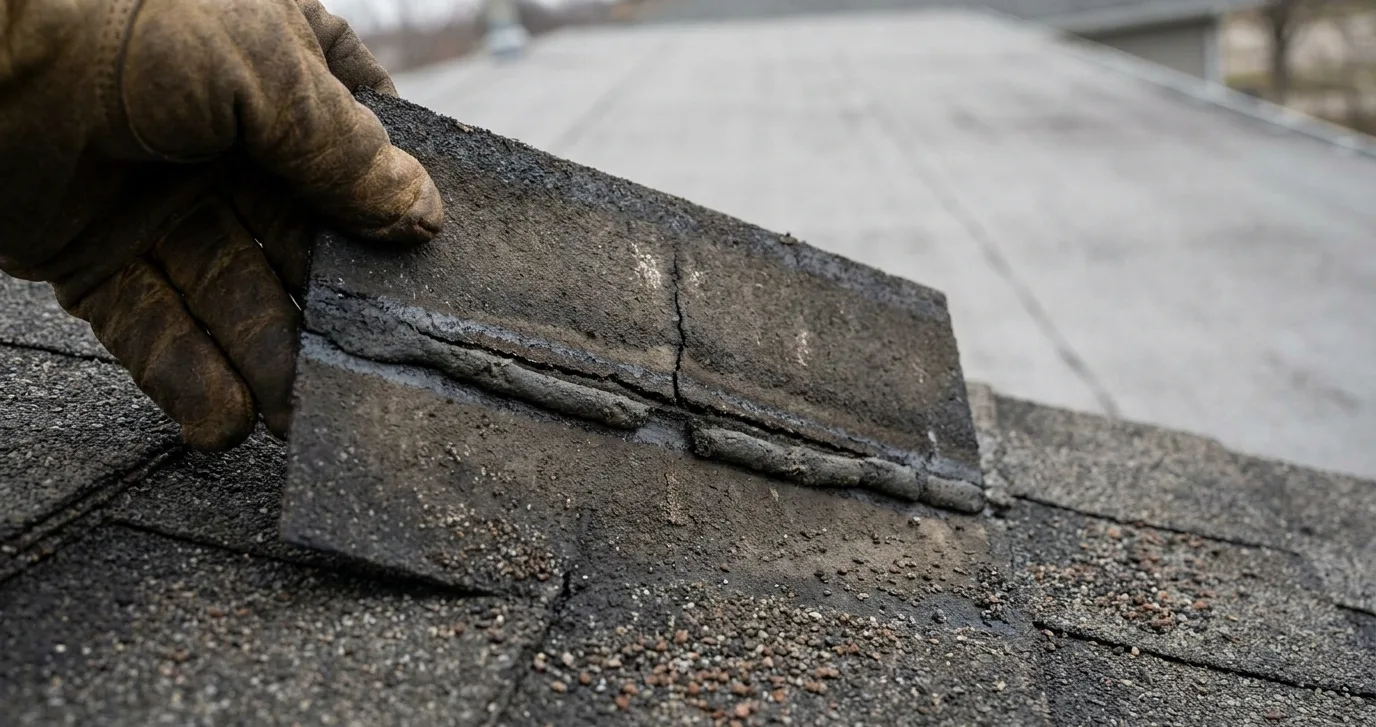
Wind gets under an edge, folds the tab back and cracks the mat along the fold. It can lie back down looking untouched and still be broken. This is the damage people miss from the ground, and it is why we go up after a storm.
A thick ridge of ice at the eaves in February
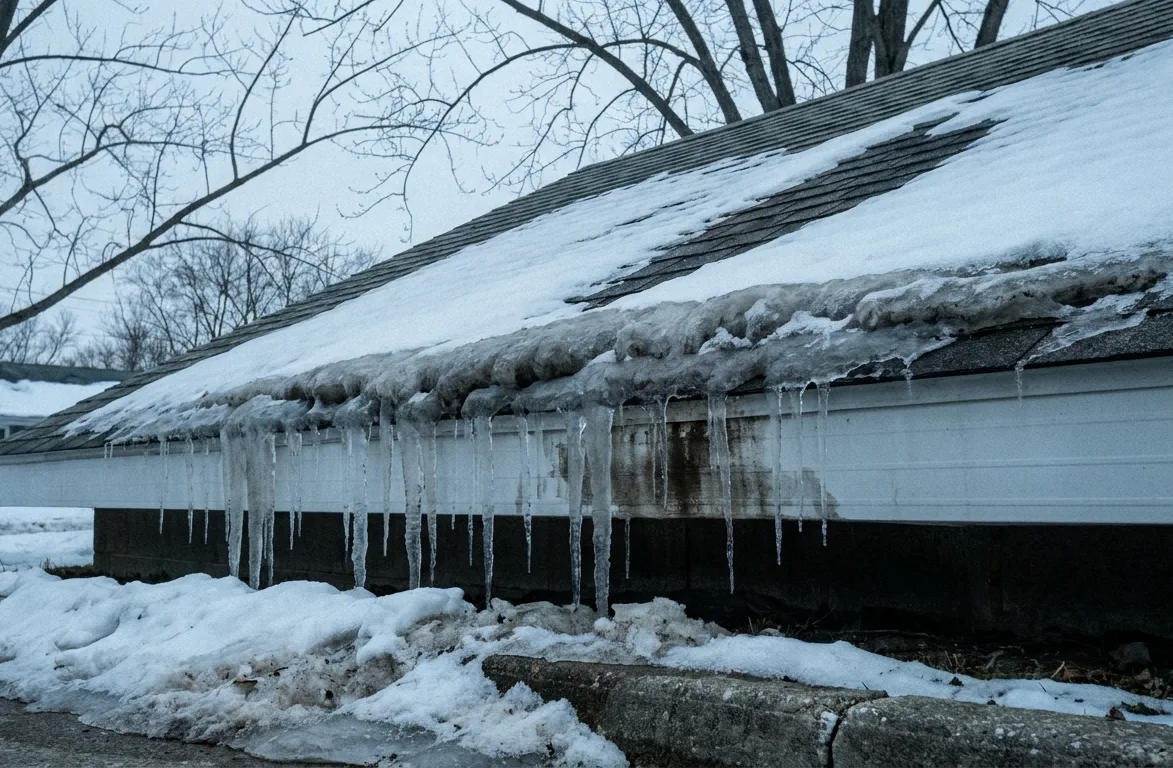
Warm air escaping into the attic melts snow high on the slope, the water runs down to the cold overhang and freezes there, and the pool behind it works its way back under the shingles. The roof is the victim here, not the cause.
Dark streaks running down a north slope
Airborne algae, not soot and not rot. It is a cosmetic problem that thrives in our humid summers, it does not shorten the roof's life, and it does not need a replacement — anyone telling you otherwise is selling.
Nail heads standing proud in a straight line
Decking moving with the seasons pushes fasteners back out. Each one lifts the shingle above it slightly and leaves a hole where the head used to sit. An hour's work to put right, and a long story if it is left.
Repair, replace, or leave it alone
Three honest answers, and a lot of roofing companies only ever give the middle one. What decides it is not the age on the paperwork — it is the condition of the shingle mat, how much of the roof is affected, and whether the deck underneath is still sound. Here is how the call gets made at your house:
- A repair when the failure is local and the rest of the field is healthy. A cracked pipe boot, a run of loose step flashing at a chimney, a dozen tabs lost off one rake edge. The shingles around the work still bend without snapping, which is the test that matters.
- A replacement when the mat itself has gone brittle across whole slopes, when the granule loss is general rather than patchy, or when there are already two layers up there. Patching a roof in that condition buys a season and leaves you paying twice.
- Nothing at all more often than you would think. Algae streaking, a bit of curl at the very oldest courses, or a stain that turns out to be a bathroom fan venting into the attic rather than a hole in the roof. We will say so and go.
When it genuinely is borderline, you get told that too, along with what a repair would likely buy you in years. That is your decision to make with real numbers in front of you, not ours to make for you on a doorstep.
What Northwest Indiana weather does to a roof
Roofs here are not wearing out from sunshine. They are being worked, hard, by three separate things, and each one attacks a different part of the assembly.
The first is the freeze-thaw cycle. Lake County crosses the freezing point dozens of times between November and March, and every crossing means water that soaked into a seam, a nail hole or a hairline crack expands as it turns to ice and levers the gap a little wider. Nothing on a roof survives that indefinitely — sealant strips let go, flashing joints open, and old caulk at a chimney turns to crumbs.
The second is snow that sits. We are far enough east of the lake to catch real accumulation and cold enough to keep it on the roof for weeks rather than days. Standing snow keeps the deck damp, loads the structure, and gives an under-insulated attic every opportunity to build the ice dam that follows.
The third arrives in summer. The storm line that comes across the Illinois border on a July afternoon brings straight-line wind and, several times most years somewhere in the county, hail. Wind takes tabs off exposed edges; hail bruises the mat in a scatter of soft spots that will not leak this year but will have failed within a few.
What working with us looks like
You call
Somebody who climbs roofs answers at (219) 373-1772. We ask what you are seeing, whereabouts in the house, whether it follows particular weather, and roughly how old the roof is if anyone knows.
We get on the roof, not just in the driveway
A roof cannot be assessed from a truck window. We walk the slopes where it is safe to, check the flashings and the penetrations, and put our head into the attic to look at the deck from below.
You see what we saw
Photographs of every problem area, taken up there and gone through with you at ground level. If we say a boot is split or a valley is worn through, you get to look at it.
The price is written down before anything starts
Scope, materials, what is included and what is not. You read it and decide in your own time. Nothing comes off the truck until you say so.
We work, then we clean up properly
Tear-off goes into a covered trailer, the beds and the drive get protected first, and the magnet goes over the whole property afterwards — twice, because the first pass never gets all of them.
What the code actually requires on a roof in Lake County
Indiana does not set one roofing standard for the whole state. The 2020 Indiana Residential Code carries a table of climatic and geographic design criteria, amended into the Indiana Administrative Code at 675 IAC 14-4.4-5, and it lists every county separately. Lake County sits in the harder half of it, and the row is worth reading if you are about to buy a roof here.
| Criterion | Lake County | Marion County (Indianapolis) | What it means on your roof |
|---|---|---|---|
| Ice shield underlayment | Required | Not required | Lake County is one of the counties where the code always calls for an ice barrier at the eaves. Much of central Indiana is not. |
| Ground snow load | 30 psf | 20 psf | Half again as much design snow sitting on the structure, and considerably more meltwater looking for a way in underneath it. |
| Air freezing index | 2,000 | 1,500 or less | A measure of how hard and how long it freezes. It is the number behind the freeze-thaw cycling that opens seams and flashing joints. |
| Winter design temperature | 1°F | 2°F | What the assembly is expected to work at, not the coldest it ever gets. |
| Weathering | Severe | Severe | Severe statewide — the freeze-thaw exposure applies to masonry and to anything mortared, including the chimney your flashing is let into. |
| Ultimate design wind speed | 115 mph | 115 mph | Also statewide. It is a design figure with a long return period, not a forecast, and it is not the same thing as a gust anybody has measured. |
Source: Table R301.2(1), Climatic and Geographic Design Criteria, as amended into the Indiana Administrative Code at 675 IAC 14-4.4-5 (2020 Indiana Residential Code, adopting the 2018 IRC). County rows 45 (Lake) and 49 (Marion).
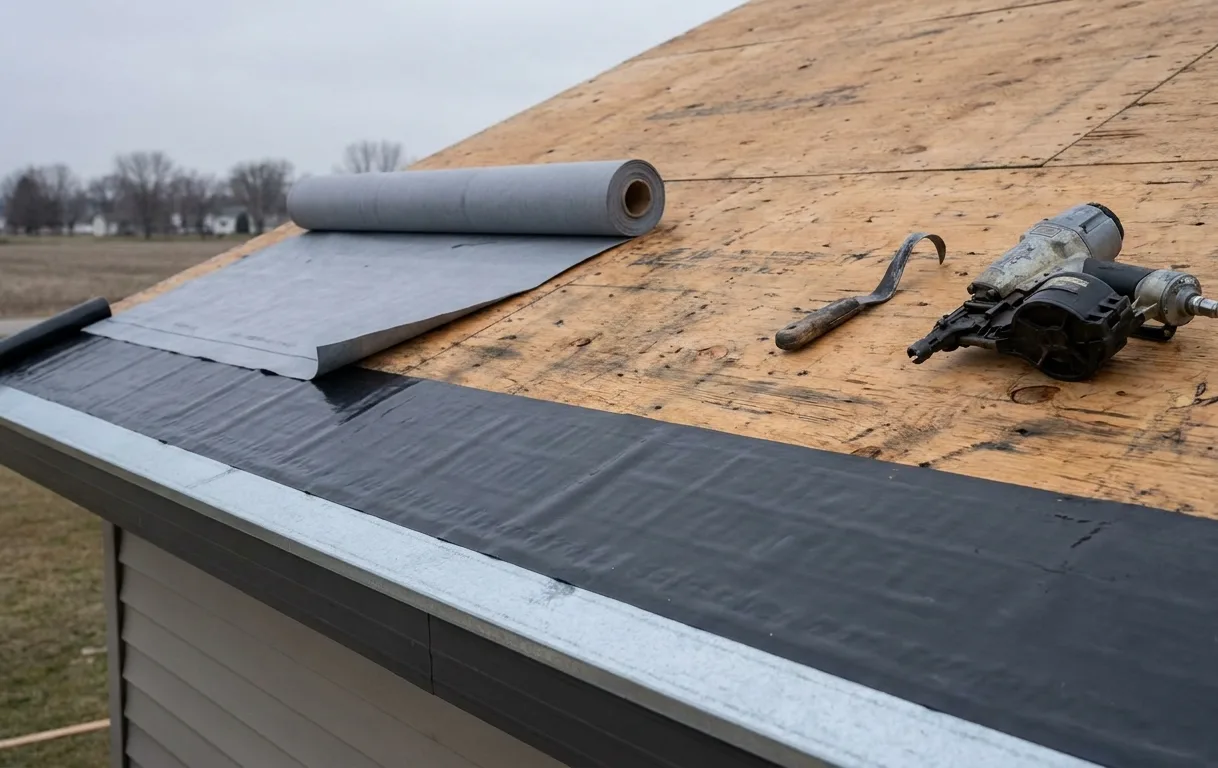
The practical consequence sits at the eaves. Where the table says an ice barrier is required, the code wants a self-adhering membrane running from the roof edge to a line at least 24 inches inside the exterior wall of the house — further on a steep roof. That membrane is invisible the day the job finishes and it is the single component most likely to decide whether February puts water on your ceiling.
How often it actually hails here
Hail is the part of this trade where guessing is most expensive, so it is worth using the record rather than an impression. The National Centers for Environmental Information keep a public storm events database, and Lake County has its own entries in it.
Across the eleven years from 2015 to 2025 the database holds 32 hail reports for Lake County — an average of about three a year. Twenty-nine of those were an inch across or bigger, which is roughly a quarter and the size at which asphalt shingles start taking real damage. Six were an inch and three quarters or more, golf-ball size and up. The largest logged in that period was 2.75 inches, on 13 July 2015.
Severe thunderstorm wind is the more frequent event by a wide margin: 151 reports over the same eleven years, about fourteen a season, every one of them at 58 miles an hour or above because that is the threshold at which the service logs one at all. The strongest measured gust in the county over that period was 96 miles an hour, in July 2017.
Two things follow from that. Wind, not hail, is what most Lake County roofs actually meet — and it arrives often enough that a roof edge which was never sealed properly will be found out. And hail here is a real but occasional event that lands in narrow bands: the golf-ball reports in that window came from St. John, Schererville and Dyer on three separate days, while Crown Point's own two logged reports were both an inch, one of them in February.
What actually drives the cost of a roof
We price at the house, because until somebody has been up there any figure is invented. What we are weighing when we do price it is nearly always these five things, and knowing them lets you read any estimate you are handed — ours or anybody else's:
- How steep it is and how many planes it has. A simple gable that can be walked is one job. A cut-up roof with six valleys, three dormers and a slope nobody can stand on is another, and the difference is measured in days rather than materials.
- What is already up there. One layer of shingles comes off cleanly. Two layers is twice the tear-off, twice the disposal, and it is also the point at which the building code stops letting anybody add a third.
- The condition of the deck. Nobody knows this until the old roof is off. Soft sheathing has to be replaced, and a house with plank decking rather than sheet goods may need more of it than you would like. This is the line item that moves after work has begun, so it belongs in the estimate as a stated rate rather than as a surprise.
- The details, not the field. Chimneys, skylights, sidewall junctions, valleys and vents are where the labour and the skill go. A roof with none of them costs far less than its square footage suggests; a roof with all of them costs more.
- What you choose to put back. An architectural shingle, an impact-rated one and a standing-seam metal roof are three very different products with three very different service lives, and the right answer depends on how long you plan to own the house.
What you will not get from us is a number over the phone. Anyone who quotes your roof without seeing it is either guessing high enough to be safe or low enough to get in the door, and both of those end the same way.
Replacement, inspections and gutters
Roof Replacement
Full tear-off, the deck inspected with you, ice barrier at the eaves and ventilation that actually balances.
Roof Inspection
Slopes, flashings, penetrations and attic checked, with a written report and photographs you keep.
Gutter Installation
Seamless aluminium sized to the roof above it, hung on hidden hangers, water carried clear of the foundation.
Communities we cover
- Crown Point
- Winfield
- Merrillville
- Cedar Lake
- Lowell
- Schererville
- St. John
- Dyer
- Griffith
- Hobart
- Hebron
- Valparaiso
Frequently asked questions
How long does a roof last in Lake County?
Less than the wrapper promises, because the wrapper was not written for our winters. A standard three-tab that is rated for a couple of decades elsewhere is often tired here well before that, and an architectural shingle on a well-ventilated attic will comfortably outlive one on a hot unvented one. Ventilation and installation quality matter more to the outcome than the brand on the bundle.
Can you put a new roof over the old one?
The code lets you have two layers, so on a house with one layer it is physically possible. We do not do it. You are burying the deck where nobody can inspect it, adding weight, and making the next tear-off worse — all to save a fraction of one job while shortening the roof you are paying for.
Do I need to be home while you work?
For the estimate, yes — it is the walkthrough of the photographs that makes it worth anything. For the work itself, not necessarily, though most people want to be there for the start of the tear-off and for the final walk round.
How long does a roof replacement take?
A straightforward house is usually a single working day for the tear-off and the new roof, with a second day when the roof is complicated, the deck needs work, or the weather closes in. We do not open up more roof than we can dry in before we stop.
What happens if it rains partway through?
That is a planning question rather than an emergency one. We watch the forecast, we strip in sections rather than all at once, and everything open at the end of a day is either shingled or covered and weighted. Getting caught out is a scheduling failure, not bad luck.
Will you work with my insurance company?
We document what we find with dated photographs and a written scope, and that is what an adjuster needs. We are happy to be on the roof at the same time as yours. What we will not do is tell you your roof is a claim before we have looked at it, or find damage that is not there.
Do you do anything about ice dams?
Yes, and the useful work is usually not on the roof surface. Ice dams are an attic problem wearing a roof costume — air leaking up from the house, insulation that stops short at the eaves, intake and exhaust ventilation that do not balance. We put a membrane at the eaves when a roof is replaced, and we will tell you what is going on above your ceiling.